
Landscape Lighting · September 21, 2026 · 9 min read
2700K Or 3000K: Choosing Landscape Lighting Color Temperature In The Desert
Color temperature decides whether desert plants and stone look right after dark. Here is how we choose between 2700K and 3000K on Valley properties.
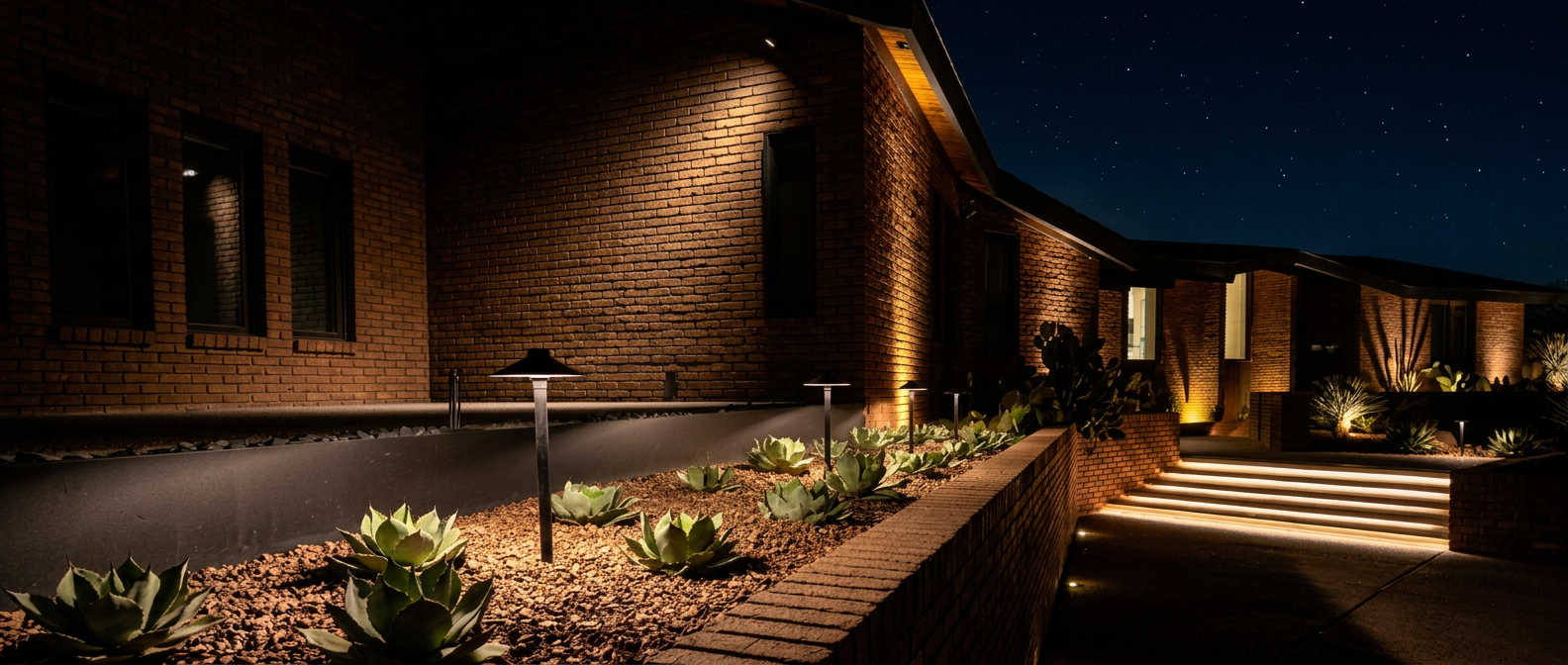
Color temperature is the single specification that decides whether a lit yard looks like a home or a parking lot, and most people never get asked about it. Two systems with identical fixtures, identical placement and identical wattage can read completely differently because one was built at 2700K and the other at 4000K. On desert properties the stakes are higher than in a green climate: our plant material is silver, blue and gray, our stone is warm tan and rust, and cool light drains the color out of both. This is how we pick color temperature for landscape lighting in Scottsdale and across the Valley, and where we break our own rule.
What Color Temperature Measures, And What It Does Not
Color temperature is measured in Kelvin and describes the appearance of the light, not its brightness. A 2700K lamp and a 4000K lamp at the same lumen output put the same amount of light on a wall. One reads amber and candle-like, the other reads blue and clinical.
The second number that matters is CRI, or color rendering index, which describes how accurately the light shows the true color of what it hits. A cheap 3000K fixture at 70 CRI will make a blue agave look gray and a rust boulder look brown. We specify 90 CRI and above on anything that lights plant material or natural stone, because in the desert the color of the material is most of the design.
- 2700K: warm, close to halogen, flattering on stucco, stone and wood
- 3000K: still warm but cleaner, reads whiter on light surfaces
- 4000K and above: cool and commercial, rarely appropriate on a residence
- CRI 90+ matters as much as the Kelvin number on planting and stone
Why The Desert Palette Pushes Us Warm
Walk a Paradise Valley property in daylight and look at what the light will hit after dark: travertine, sandstone, rusted steel, tan stucco, decomposed granite. Those are warm materials. Warm light on warm material deepens the color and shows the texture. Cool light on the same surfaces flattens them to a gray-green that looks nothing like the daytime property.
The exception is plant material. Agave, blue palo verde, silver mountain gem and brittlebush all carry cool pigment, and at 2700K that silver-blue shifts noticeably toward yellow. This tension, warm hardscape against cool planting, is the real design problem, and it is why we rarely build an entire property at one temperature.
Our Default: 2700K On Architecture, 3000K On Plants
On most Valley homes we run 2700K on everything architectural: wall grazing, column uplights, soffit downlights, step and path lighting near the house. It matches the interior lamps visible through the glass, which is what makes a lit house read as one continuous scene rather than an exterior display bolted onto a dark building.
Plant material gets 3000K. That 300 Kelvin difference is small enough that nobody standing in the driveway names it, and large enough that a blue agave stays blue and a saguaro's green skin stays green instead of going khaki. The split is subtle by design. If a guest can point at the line where the temperature changes, we chose wrong.
- 2700K: stucco, stone veneer, columns, soffits, steps, path lights near the house
- 3000K: agave, cactus, palo verde, olive canopy, ornamental grasses
- Match the temperature of any existing interior lighting visible through glass
- Never mix temperatures on two fixtures aimed at the same surface
Where Cooler Light Genuinely Belongs
There is one place we go cooler on purpose: moonlighting. Downlights mounted high in a mesquite, ironwood or palo verde canopy are imitating moonlight filtering through branches, and real moonlight is cool. At 2700K a downlight reads like a porch bulb stuck in a tree. At 3000K, or 3500K in a tall canopy over open gravel, it reads like light coming from the sky.
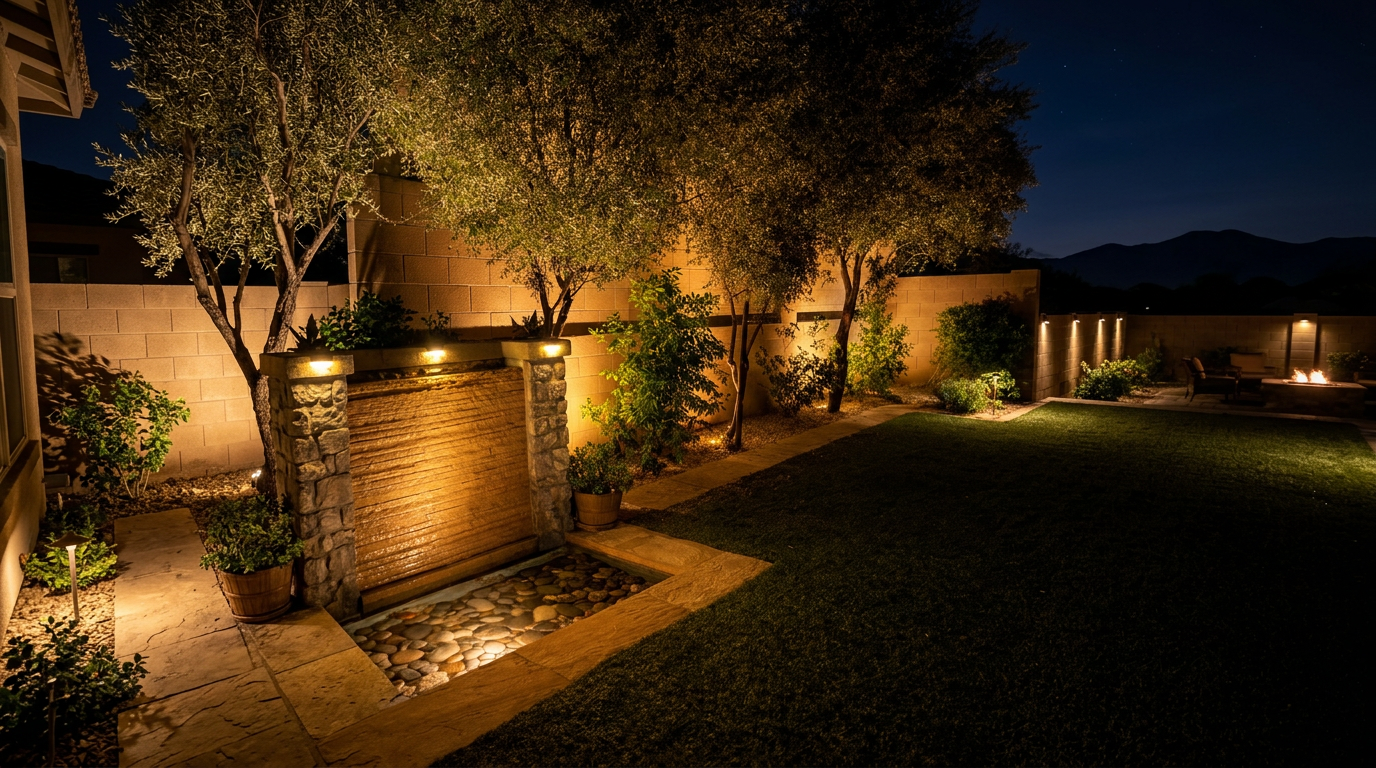
Water is the other case. A pool or a sheer descent lit at 2700K takes on a yellow-green cast that people read as dirty water. Pool and fountain lighting stays at 3000K or cooler, and we keep it separate from the warm wash on the surrounding decking so the water reads clean against a warm perimeter. You can see both approaches running together in the project photography in our gallery.
Matching The House, Not The Catalog
Before specifying anything we turn on the interior lights at dusk and look at the house from the street. A home with 2700K recessed cans and warm decorative fixtures throughout needs exterior light in that range, otherwise the windows glow amber against a bluish facade and the whole elevation looks off balance.
Newer builds are frequently different. A lot of contemporary Scottsdale and Arcadia homes run 3000K interiors with cooler accent lighting, and matching that at 3000K outside is the correct call even on warm stone. The rule is not a Kelvin number, it is coherence between what is inside the glass and what is outside it.
Color Temperature And Dark Sky Compliance
Several Valley jurisdictions have adopted outdoor lighting standards that cap correlated color temperature, commonly in the 2700K to 3000K range, alongside shielding and curfew provisions. Warm light scatters less in the atmosphere than blue-heavy light, which is why the caps exist. Confirm the current municipal ordinance and your HOA design guidelines before finalizing a fixture schedule, because these rules are revised and they vary between neighboring cities.
In practice this rarely constrains a residential design, since a warm palette is what looks right anyway. Where it does bite is on cool downlighting in tall canopies and on pool lighting, so those two items belong in any submittal conversation. We cover the approval process in more detail in our guide to dark sky lighting rules in Scottsdale and Paradise Valley, and it applies across Paradise Valley and Scottsdale alike.
Consistency Across Fixtures And Over Time
A specification of 3000K means nothing if the fixtures come from three manufacturers. Binning tolerance is the reason: two lamps both labeled 3000K can sit visibly apart in actual output, and once they are on the same wall the mismatch is obvious. We hold a single manufacturer and a tight binning spec across a property for exactly this reason.
Drift over time is the second half of the problem. LED modules shift slightly as they age, and heat accelerates it. In an Arizona summer, a fixture buried in gravel with no airflow runs hotter than the same fixture in a Midwestern lawn, so replacing one failed lamp on a five year old wall wash with a fresh one out of the box often leaves a visible patch. Replacing the run rather than the single lamp is usually the right call, which is the same logic we cover in low voltage lighting maintenance.
- Hold one manufacturer and one binning spec across the whole property
- Keep spare lamps from the original batch for future replacements
- Expect to replace a full run rather than one lamp on aged systems
- Heat in gravel beds accelerates color drift, so ventilation and fixture choice matter
Adjustable And Tunable Options, And When They Are Worth It
Some fixture lines offer field-selectable color temperature via a switch on the fixture, typically 2700K, 3000K and 3500K. On a large property where planting will mature and change over a decade, that flexibility has real value, and it costs little more than a fixed lamp.
Fully tunable systems that shift temperature from a controller are a different proposition. They carry a meaningful cost premium and add a layer of control hardware to maintain, and most homeowners settle on one setting within a month and never change it again. We recommend them for entertaining properties with distinct scenes, and steer away from them when the goal is one good look every night.
Questions To Ask Before You Sign A Lighting Proposal
A proposal that does not name a Kelvin value and a CRI value is not a specification, it is a price. Ask for both in writing, per fixture type, along with the manufacturer.
Then ask to see it. A competent contractor will set up a temporary demonstration on your own wall and your own plants at dusk, because no photograph settles this question. Seeing 2700K and 3000K side by side on your stone takes five minutes and prevents a decision you live with for ten years.
- What Kelvin and what CRI, per fixture type, in writing
- One manufacturer across the property, or a documented reason why not
- A dusk demonstration on the actual materials before installation
- How replacement lamps will be matched in three to five years
Getting The Specification Right The First Time
Color temperature is cheap to get right during design and expensive to correct afterward, because fixing it means relamping or replacing an entire system that is already buried, aimed and wired. It deserves more attention than it usually gets in a sales conversation.
We walk properties in daylight to read the materials, come back after dark to test on the actual surfaces, and put the Kelvin and CRI values on the fixture schedule before anything is ordered. If you are planning a system, or looking at a proposal that does not say what temperature it uses, get in touch and we will walk through it with you.
Frequently Asked Questions
Planning A Project?
We walk the property in daylight, come back after dark, and design the system around what your home actually needs.
Continue Reading
Landscape Lighting · 8 min read
Dark Sky Lighting Rules in Scottsdale and Paradise Valley
Landscape Lighting · 8 min read
How to Light a Saguaro Without Damaging It
Planning & Design · 8 min read