
Landscape Lighting · July 15, 2026 · 8 min read
How to Light a Saguaro Without Damaging It
Saguaros are protected, slow growing and easy to harm with the wrong fixture. Placement, heat, root zones and beam control all matter.
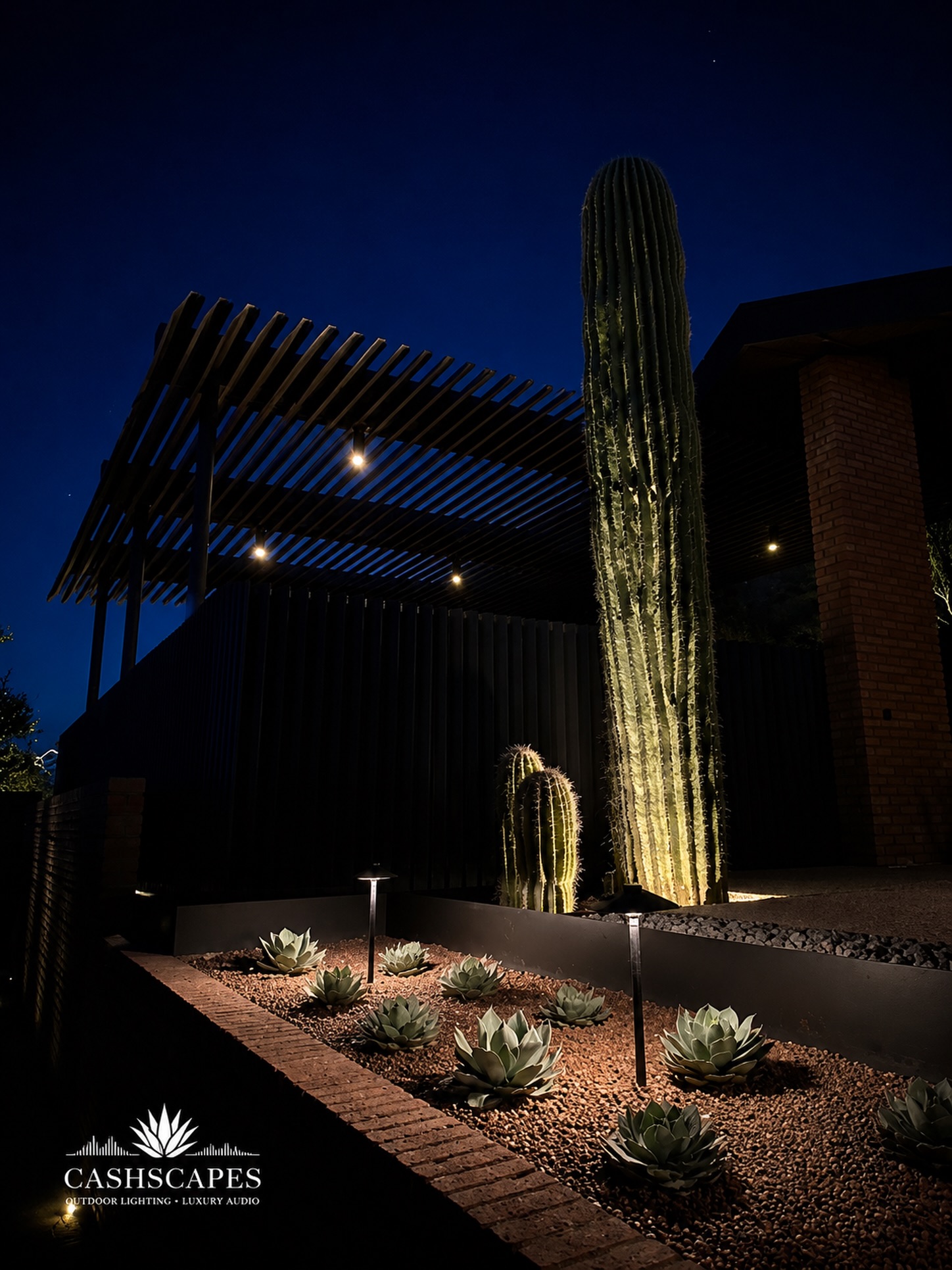
A lit saguaro is the signature image of desert landscape lighting, and it is also the easiest thing on a property to get wrong. These plants are protected by Arizona law, they take decades to reach the size that makes them worth lighting, and the roots you cannot see are wider than the canopy you can. This is how we light them across Scottsdale, Cave Creek and the rest of the Valley without putting the plant at risk, and the choice of color temperature on desert planting matters as much here as fixture placement does.
Understand The Root Zone First
A mature saguaro has a shallow, wide root system that radiates out roughly as far as the plant is tall, sitting only a few inches below the surface. That entire area is fragile.
This single fact governs everything else. Trenching through it, driving a stake through it or setting a fixture inside it can injure a plant that took eighty years to reach that height.
Where The Fixture Goes
We set uplights outside the root radius wherever possible and use a narrow beam to reach the trunk from a distance. Doing that well takes better optics and more careful aiming than pushing a fixture up against the base.
When a fixture has to sit closer, we hand dig, work around roots rather than through them, and mount to a surface or stake placed in a gap rather than driven blind.
- Hand dig within the root radius, never trench
- Prefer narrow beam optics from a greater distance
- Never mount hardware to the plant itself
- Keep fixtures far enough back that maintenance access stays clear
Heat Is The Other Risk
Halogen fixtures put out real heat, and sustained heat against cactus flesh causes scarring that never grows out. This is the main reason we do not install halogen near plant material.
Modern LED fixtures run cool at the lens, which makes close placement far safer. Even then we leave clearance for air movement and avoid pointing a hot spot at one small area of the trunk night after night.
Beam Angle And Trunk Coverage
Tall saguaros need a narrow beam, often ten to fifteen degrees, to carry light from the base to the arms without blasting the surrounding area. Wide floods waste output and light the sky.
For a plant with arms, two fixtures at an angle to each other read better than one straight on. Cross lighting reveals the ribs and gives the plant depth instead of flattening it into a silhouette.
Output Levels That Look Natural
The most common mistake is too much light. A saguaro lit at full output looks like a stage prop. Lower output with good aiming looks like moonlight found it.
We dial output during night aiming, on site, with the client present. What looks correct on a spec sheet rarely matches what looks correct standing in the yard.
Protected Plant Rules
Saguaros are protected under Arizona native plant law, and many municipalities add their own requirements around disturbance and removal. Damage caused during a landscape installation is a real liability, not a theoretical one.
Any crew working near a mature specimen should know this before they arrive with a shovel. It is one of the questions worth asking any contractor bidding on your yard.
Lighting Other Desert Species
Ocotillo reads best backlit or grazed, because the value is in the line of the canes rather than the mass. Agave and barrel cactus look best with a low, tight fixture that catches the edges of the leaves.
Ironwood, palo verde and mesquite are the opposite: they are canopy plants, and they belong in downlighting. A fixture mounted in the canopy throws branch shadows across the ground and creates the moonlight effect that makes a yard feel established. Examples of both approaches are in the gallery.
Maintenance Around Mature Plants
Desert plants grow, and lighting that was aimed correctly three years ago may now be pointing into a new arm or blocked by fill in growth. Annual re aiming keeps a system looking designed.
We also check for gravel migration, which slowly buries in ground fixtures and turns a clean uplight into a dim glow in the rock. It takes minutes to correct and is the most common reason a system looks tired.
Bringing It Together On A Property
A finished desert lighting plan usually mixes a small number of specimen uplights with canopy downlighting and low path lighting. The specimens carry the drama, the canopies fill the space, and the path lights make it usable.
If you have mature saguaros you want lit properly, we will walk the property, mark the root zones and design around them. Reach us through the contact page or read about our full landscape lighting process.
Frequently Asked Questions
Planning A Project?
We walk the property in daylight, come back after dark, and design the system around what your home actually needs.
Continue Reading
Landscape Lighting · 8 min read
Dark Sky Lighting Rules in Scottsdale and Paradise Valley
Landscape Lighting · 9 min read