
Landscape Lighting · October 12, 2026 · 8 min read
Tree Uplighting For Desert Trees: Mesquite, Palo Verde, Olive, And Palm
Tree uplighting for Arizona yards: how to light mesquite, palo verde, olive, and palm trees, with fixture counts, placement, beam angles, and glare control.
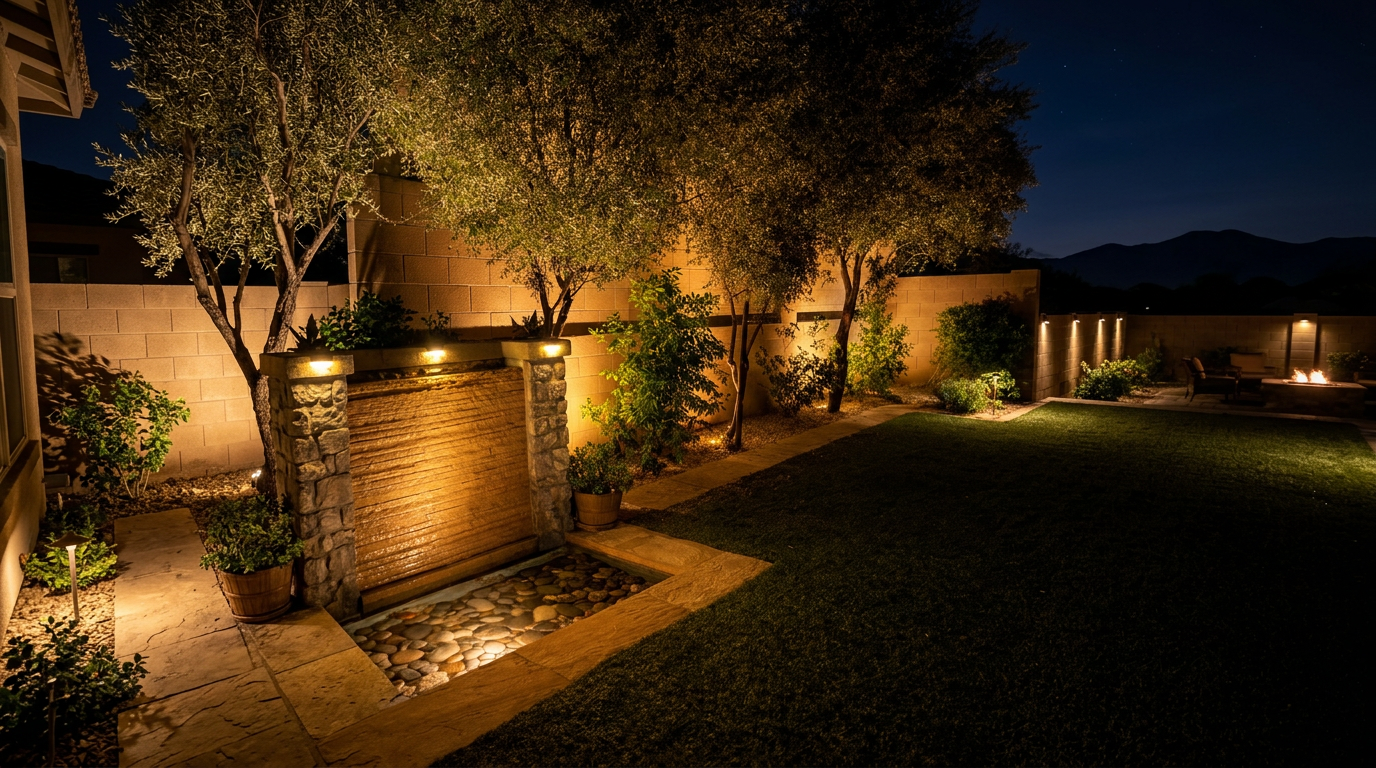
Tree uplighting does more to set the mood of a desert yard at night than any other single move, and it is also where most installs go wrong. A mesquite, a palo verde, an olive, and a palm each have a different canopy, bark, and trunk, so one fixture pushed against the base of every tree gives four different bad results. Good landscape lighting starts with reading the tree: where the structure is, what the canopy does in the wind, and where people will be standing when they look at it.
What Tree Uplighting Is Supposed To Show
The goal is not to make a tree bright. The goal is to show its shape: the twist of a mesquite trunk, the green bark of a palo verde, the silver underside of olive leaves, the clean column of a palm. When a tree is lit well you read its structure from across the yard and you never notice the fixture.
That means light has to land on the parts of the tree worth seeing and stay off the parts that are not. Bare lower branches, a trunk wrapped in drip line, or the back side of a canopy against a neighbor's wall all waste light and pull the eye in the wrong direction.
How Many Fixtures A Tree Needs
One fixture lights a tree from one side, which flattens it. Two fixtures from different angles give depth, and that is our starting point for any tree that will be seen from more than one spot. A large multi trunk mesquite or a broad olive in a courtyard often takes three.
Count from the viewing positions, not from the tree. If the tree is seen mostly from the back patio, the main fixture goes on the patio side and a second, softer fixture fills from the side. A tree seen from the street, the driveway, and the pool deck needs coverage from all three directions or one view will always look like the back of a stage set.
- Small accent tree or young palo verde: one or two fixtures
- Mature mesquite, ironwood, or olive: two or three fixtures
- Single trunk palm: one or two fixtures, depending on height
- Specimen tree seen from several areas: one fixture per main view
Mesquite And Ironwood: Light The Structure
Mesquite and ironwood are all about the trunk and the branch pattern. The canopy is fine and lets light through, so a fixture placed too close to the trunk shoots straight up through the leaves and lights nothing. We set fixtures 2 to 4 feet out from the trunk and aim back into the main branch junctions so the bark and the forks catch the light.
A medium beam, around 35 to 40 degrees, works for most mature trees. These trees also move a lot in monsoon wind, and the shadow play that creates on a wall behind them is one of the best effects in a desert yard. If there is a stucco wall nearby, place one fixture so the canopy throws shadows onto it.
Palo Verde: Show The Green Bark
The palo verde canopy is thin and its leaves drop in heat and drought, so for much of the year the tree is mostly bare green limbs. That bark is the feature. A warm, wide beam from close to the base washes the trunk and lower limbs, and a second fixture farther out picks up the upper branch structure.
Watch the color temperature here. Very warm light can turn the green bark muddy. We often run palo verdes at 3000K while keeping the house at 2700K, which is covered in more detail in our guide to choosing color temperature in the desert. Palo verdes also shed a lot of litter, so fixtures need shrouds or glass that sheds debris, or they will be dim within a season.
Olive Trees: Light From Inside And Below
Olives have dense, silvery canopies and sculptural trunks, and they are common in courtyards on older lots in Arcadia. Uplighting the canopy from outside only lights the surface leaves. The better approach is one fixture aimed at the trunk and a second tucked closer in, aimed up into the canopy so light glows through the leaves from inside.
For a large olive, a downlight mounted high in the tree and aimed through the branches gives the moonlight effect: soft dappled light and leaf shadows on the ground below. Combined with uplighting from below, that makes the tree feel lit from inside rather than spotlit from the lawn.
- Trunk fixture: medium beam on the main trunk and lower forks
- Canopy fixture: narrow or medium beam aimed up through the interior
- Optional moonlight: downlight mounted high, aimed through branches
- Use mounting straps that allow for growth, never wrap or nail tight
Palms: Narrow Beams And Height
Palms are the most common mistake we fix. A wide fixture at the base of a 30 foot palm lights the bottom 10 feet of trunk and leaves the crown dark, which is the part people want to see. Tall palms need narrow beams, often 10 to 25 degrees, aimed so the light runs up the trunk and lands in the fronds.
Set the fixture 1 to 3 feet off the trunk and angle it so the hot spot hits the base of the crown. For very tall palms, two narrow fixtures from opposite sides keep the crown from looking lopsided. On the large estate lots around Scottsdale, a row of palms lit with matched narrow beams reads from far down the driveway.
Fixture Placement And Glare Control
An uplight that is visible from where people sit is a failure, no matter how good the tree looks. The fixture should sit behind a boulder, inside a planting bed, or below grade in a well light, and it should point away from the patio, the windows, and the street. Shrouds, louvers, and glare guards on the fixture keep the lamp out of sight.
Placement also has to respect the neighbors and local rules. Light aimed straight up past the canopy goes into the sky, and in many Valley cities and HOAs that is restricted. Keep beams inside the canopy and confirm current municipal and HOA lighting rules before final aiming, since they differ by city and change over time.
- Hide every fixture from the main seating and viewing spots
- Use shrouds or louvers on any fixture near a walkway
- Keep the beam inside the canopy, not past it into the sky
- Leave room to re aim as the tree grows
Roots, Irrigation, And Desert Wear
Trenching too close to a mature tree can cut feeder roots, so we route wire along the drip line and hand dig near the trunk. Fixtures also need to be clear of drip emitters and bubblers. Hard water spraying on a hot lens leaves a white crust that cuts output and makes the beam blotchy in a few months.
Trees grow, and a fixture aimed perfectly at install day is aimed at the wrong branch in two years. Plan a re aim visit after the first growing season and check fixtures after monsoon storms, when wind and debris knock them off target. Fixtures in brass or copper hold up best in Arizona sun and caliche soil.
Planning Tree Lighting For Your Yard
Walk the yard at night before deciding anything. Note where you sit, where guests arrive, and which trees you see from inside the house. Those spots decide which trees get lit and from which side, and they keep the design from spreading light evenly across every plant.
You can see how we handle mesquites, palms, and courtyard olives in our project gallery. When you are ready, request a consultation and we will walk the property in daylight, come back after dark with test fixtures, and show you how each tree looks before anything is buried.
Frequently Asked Questions
Planning A Project?
We walk the property in daylight, come back after dark, and design the system around what your home actually needs.
Continue Reading
Landscape Lighting · 9 min read
2700K Or 3000K: Choosing Landscape Lighting Color Temperature In The Desert
Landscape Lighting · 8 min read