Outdoor Audio · September 14, 2026 · 9 min read
Poolside Speakers: Where They Go and Why Placement Decides Everything
Water, hard decking and equipment noise make a pool the hardest place in the yard to get sound right. Here is how poolside speakers should be placed.
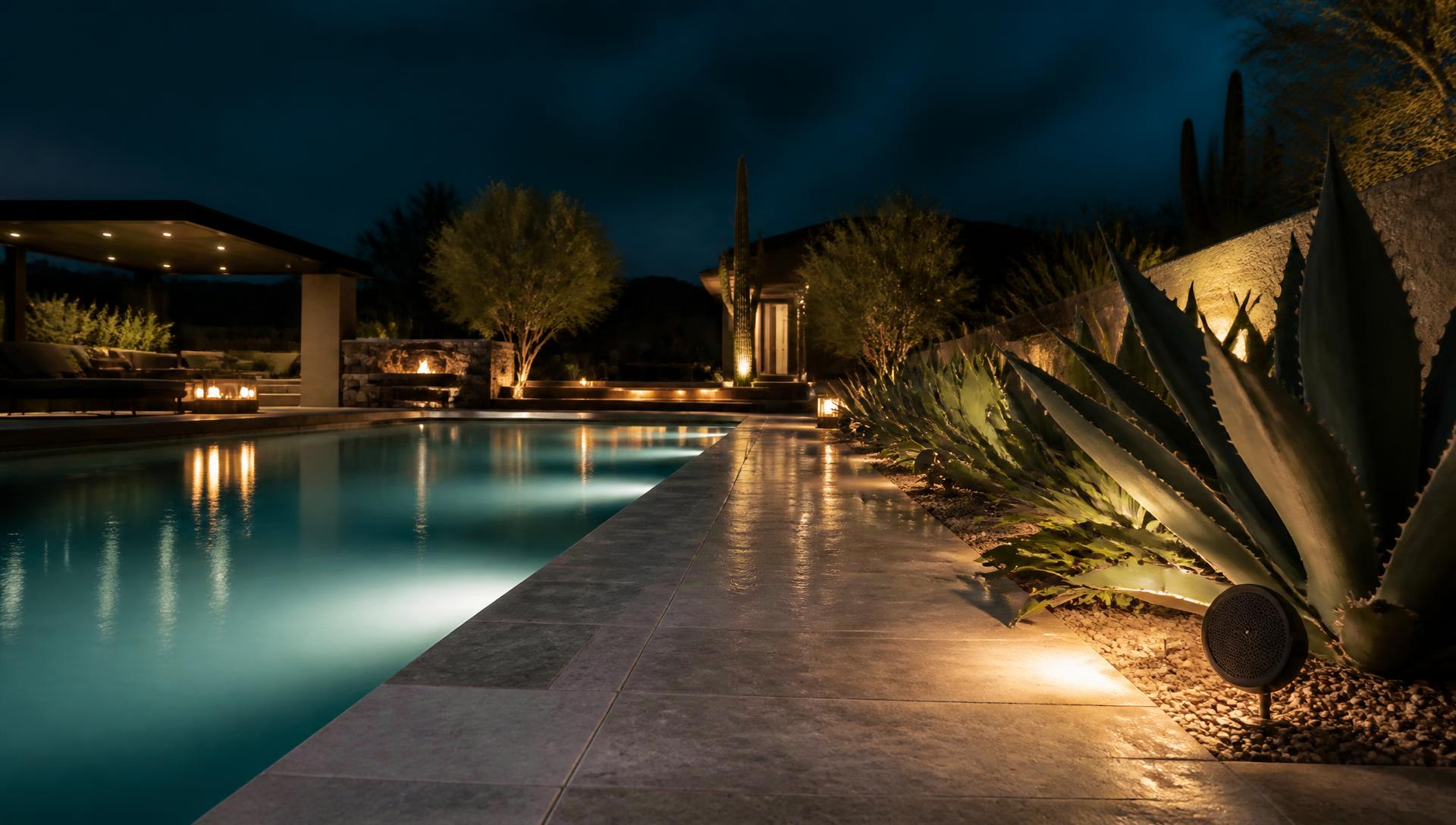
A pool deck is the hardest surface in the yard to put music on. Everything around it reflects sound, the pool equipment adds a constant floor of noise, and the places people sit are spread across a wide, awkward shape. Most poolside speakers disappoint for one reason, and it is almost never the speaker itself: they were placed where mounting was easy instead of where listening happens. This is how we plan outdoor audio around a pool on Valley properties, and what to decide before anything gets buried or mounted.
Why A Pool Deck Behaves Differently Than A Lawn
Grass and planting beds absorb sound. Travertine, concrete, pavers, plaster and water do not. A pool area is effectively a hard room with no ceiling, so anything played loudly from one point turns into slap and glare off the decking and the house wall behind it.
That is why a pair of loud speakers aimed across a pool almost always sounds harsh at the head of the deck and thin at the far end. The fix is not more power. It is more sources, each running at low volume, placed close to where people sit.
- Hard decking reflects rather than absorbs, so volume turns into harshness fast
- The water surface adds another reflective plane
- Furniture clusters are spread out, so one location cannot serve all of them
- Pool equipment runs during the same hours people are outside
Map The Listening Zones Before The Speakers
Before we place a single speaker we mark where people are: the lounge chairs, the shade structure, the dining table, the spa, the outdoor kitchen and the walk between them. Those clusters are the plan. Speaker locations follow from them.
Doing it in this order also exposes how different those areas are. The spa is a two person conversation at low volume. The dining table needs even coverage at background level. The lounge area is where a party happens. A single volume setting cannot serve all three, which is why zoning matters more here than anywhere else on the property.
Satellites Around The Perimeter, Not Across The Water
The approach that works is a ring of small satellite speakers set in the planting beds and hardscape edges around the deck, each covering the seating nearest to it. Nobody sits directly in front of a speaker, and nobody sits in a dead spot either.
Aiming matters as much as position. Satellites should fire along the deck or slightly into the seating, never straight at the house wall or across open water toward the neighbor. Sound that crosses the pool unobstructed carries well past the property line.
- Place satellites eight to twelve feet from where people sit, not fifty
- Keep them out of the splash and deck wash zone where possible
- Aim along the deck rather than into a reflective wall
- Balance both long sides of the pool so coverage is symmetrical
Where The Subwoofer Goes
Low frequency is not directional in the way mid and high frequency are, so a buried subwoofer does not need to sit in the middle of the action. What it does need is to be reasonably central to the whole pool area rather than tucked in a far corner behind a wall.
A buried sub is what allows every satellite to run at low volume and still sound full. Without it, the satellites get pushed hard to produce warmth they were never designed to make, and that is when a pool deck starts to sound brittle. The same principle drives the whole system approach we describe in outdoor audio that disappears.
Chlorine, Splash And Deck Wash
Pool chemistry is harder on hardware than rain is. A salt cell runs the deck water around 3,000 ppm of salt, and chlorinated splash plus Valley tap water at 300 to 400 ppm of dissolved minerals leaves a crust on anything within about four feet of the coping. We see it first on fasteners: a stainless screw that was rated for coastal use still blooms rust where a deck brush drags grit across it twice a week.
So the hardware spec around a pool is not the same as the spec twenty feet out in the planting beds. Poly or composite enclosures with powder coated aluminum or resin grilles hold up far better than painted steel, and every splice belongs in a gel filled direct burial connector, not a wire nut in a valve box that fills with water every time the deck gets rinsed. Where the layout allows, we set satellites just past the wet line, eight to ten feet back in decomposed granite, aimed in toward the chairs. The sound reaches the same seats, and the speaker never sits in a puddle of pool water.
- Keep speakers past the wet line where the layout allows, roughly eight feet off the coping
- Resin or composite grilles over painted metal near salt systems
- Gel filled direct burial connectors on every splice, no taped joints
- Rinse grilles with fresh water when the deck gets washed
Working Around Pool Equipment Noise
Pumps, heaters and water features run during the exact hours people are outside, and they set the noise floor the music has to sit above. A variable speed pump on low is quiet, maybe 50 dB at ten feet, but the same pump in its cleaning cycle and a gas heater firing together put the pad well above that, and on a hard deck the sound bounces rather than dissipates. If the equipment pad sits close to the seating, the answer is not more volume. It is more speakers placed nearer to people, so the music can stay at conversation level and still read clearly.
Water features get their own plan. A four foot sheer descent is loud at close range and it is broadband noise, which masks exactly the frequencies vocals live in. A satellite placed three feet from that wall will lose every time, so we either move it down the deck or give that area its own zone that runs a few dB hotter while the feature is on. We also ask when the pump actually runs. Shifting a filtration cycle to late morning, off the schedule for evening entertaining, solves more audio problems than any equipment change.
Zoning The Pool Area Separately
The pool deck should be its own zone, independent from the front elevation, the side yard and the main patio. On larger properties we often split the pool area itself into two zones, one for the primary seating and one for the spa or far end.
This is what makes the system usable rather than impressive. A quiet dinner at the table should not require the whole property to be at dinner volume, and a party at the pool should not be audible at the guest casita. Zoning is also the cleanest way to respect a neighborhood late at night, which matters on close lots in Gilbert and on estate properties in Paradise Valley alike.
- Pool deck as its own independently controlled zone
- Spa or far seating split out on larger decks
- Preset levels for background, dining and entertaining
- A scheduled late night step down in volume
Run The Wire Before The Deck Is Finished
The single cheapest decision in a poolside audio project is sleeving conduit before the decking goes down. Once travertine or pavers are set, getting wire from the equipment side of the yard to the far side of the pool means boring under a finished surface.
If you are building or resurfacing, get the speaker locations marked during rough grading. It costs very little then. It is the same conversation we have about landscape lighting, and both systems share one trenching pass when they are planned together.
Common Poolside Placement Mistakes
Most of the problems we are called in to fix repeat themselves. They come from mounting convenience rather than a listening plan.
Every one of these is avoidable at the design stage and expensive to correct after the decking is in.
- Two loud speakers on the house wall aimed across the pool
- Speakers placed where the wire already happened to be
- No subwoofer, so the satellites are pushed past their comfortable range
- Everything on one zone with one volume knob
- Indoor rated hardware installed inside the splash zone
- Speakers set directly beside a water feature they cannot compete with
Tuning The Deck After Installation
A poolside system is not finished when the last speaker is set. We walk the deck with music playing and balance levels zone by zone, sitting where people sit, until the volume is genuinely even from the spa to the outdoor kitchen.
We also listen from the property line. Done correctly, the pool area sounds full at the lounge chairs and close to inaudible at the wall. You can see finished pool and patio projects in the gallery, and we are glad to walk your deck before anything is ordered through our contact page.
Frequently Asked Questions
Planning A Project?
We walk the property in daylight, come back after dark, and design the system around what your home actually needs.
Continue Reading
Outdoor Audio · 8 min read
Outdoor Audio That Disappears: Designing Landscape Sound for Arizona Backyards

Planning & Design · 8 min read
What Landscape Lighting Costs in Scottsdale, and What Drives the Price
Planning & Design · 8 min read