Outdoor Audio · October 5, 2026 · 9 min read
Why Your Backyard Sounds Thin, And Where An Outdoor Subwoofer Belongs
Where an outdoor subwoofer belongs in an Arizona yard: buried versus above ground, placement, crossover, neighbor-friendly bass, and desert wear.
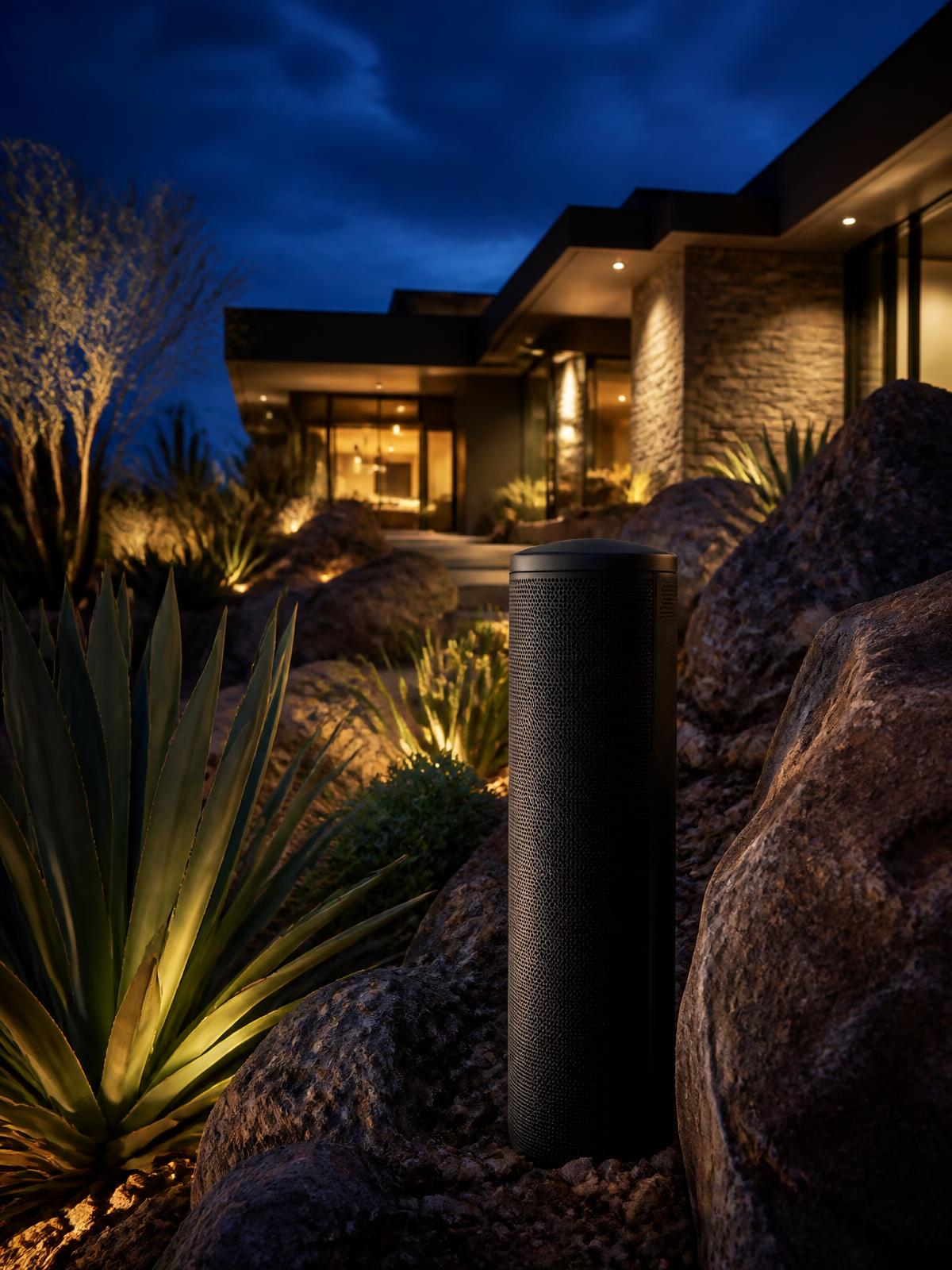
Most backyards sound thin for one reason: small satellite speakers cannot make bass outdoors, and there are no walls to help them. An outdoor subwoofer fixes that, but only if it is buried in the right spot and tuned to the satellites around it. Put it in the wrong bed and you get a boomy corner and a quiet lounge, or a low thump that carries over the block wall to the neighbor's bedroom. This is the part of outdoor audio that gets the least planning and changes the sound the most.
Why Bass Disappears Outdoors
Indoors, low frequencies bounce off walls, floors, and ceilings and pile up. Engineers call it room gain, and it is why a bookshelf speaker sounds fuller in a den than its size suggests. Outside there is one boundary, the ground, and the sound energy keeps spreading in every other direction.
A 6.5 inch satellite in a planting bed might reach down to 60 or 70 hertz on a spec sheet, but in open air you hear very little below 100. Turning the satellites up does not help. They distort, the highs get harsh near the speaker, and the bass still sounds weak from the seating area. The low end has to come from a driver built to move a lot of air.
Do You Need An Outdoor Subwoofer At All
For background music on a small courtyard, maybe not. Two or four satellites close to the seating can sound fine at low volume. Once the yard opens up, or you want music at a level where people dance at a party or follow a game from the pool, a subwoofer stops being optional.
A useful test: if the listening area is more than about 30 feet across, or the system has six or more satellites, plan for at least one sub. On the larger lots we work on in Fountain Hills and Paradise Valley, two subwoofers placed in different beds usually give more even bass across the yard than one larger unit.
- Listening area wider than roughly 30 feet
- Six or more satellite speakers on the system
- Music played at party volume, not only background level
- Pool, lawn, and patio zones that all need coverage
Buried Versus Above Ground Subwoofers
An in ground subwoofer has its enclosure buried in the soil with only a small port or vent showing at grade, usually disguised as a low cap in the planting. The earth around the box acts as a massive, rigid baffle, which helps output, and the hardware nearly disappears.
Above ground outdoor subwoofers sit in a bed and look like a landscape rock or a small planter. They are easier to install and service, and they make sense where caliche or a tight utility corridor makes digging a 2 foot hole impractical. In most Valley yards we bury them, because the whole point of landscape audio is that guests hear it without seeing it.
Where To Place The Sub In The Yard
Bass is far less directional than treble, so a sub does not need to point at anyone. It does need to sit within reasonable distance of the main listening area, ideally 10 to 25 feet from the seating, and away from the property line you share with a neighbor.
Placing it near a hard boundary, such as a garden wall or the house, adds output, since the wall reflects low frequencies back toward the yard. That works for you when the wall faces your patio and against you when it faces a neighbor's yard. We usually tuck the sub into a bed against the house or a retaining wall, facing inward, and walk the yard with test tones before backfilling.
Avoid splitting the difference between two seating areas 80 feet apart. One sub halfway between them often leaves both sounding thin. Two subs, each near its own zone, is the better design.
- 10 to 25 feet from the primary seating area
- Backed by the house or a garden wall facing into the yard
- Away from shared property lines and bedroom windows
- Out of irrigation spray and clear of drip emitters
Digging In Caliche And Desert Soil
A buried sub enclosure typically needs a hole around 2 feet deep, and across much of the Valley that means hitting caliche somewhere along the way. Caliche is cemented calcium carbonate that can be as hard as concrete. It also drains poorly, which matters for a speaker box sitting in it through monsoon season.
We break through it with a rotary hammer or a jackhammer when needed, then set a gravel base under the enclosure so water moves away instead of pooling against it. Skipping that step is how buried subs fail. The box sits in standing water after a storm, connections corrode, and the driver suspension degrades years ahead of schedule.
Amplifier Power And Crossover Settings
Subwoofers need more power than satellites. A typical buried sub wants its own amplifier channel, often 200 watts or more, rather than sharing a tap on a 70 volt line with the rest of the yard. Underpowered subs clip at volume, and a clipping sub is the fastest way to damage one.
The crossover decides which frequencies go where. We usually set the sub to handle everything below about 80 to 100 hertz and filter that range out of the satellites. That lets the small speakers play louder and cleaner, since they are no longer trying to reproduce bass they cannot make outdoors. Time alignment and phase matter too: a sub that is out of phase with nearby satellites cancels bass right where people sit, so we check it with a meter, not by ear alone.
Keeping The Neighbors On Your Side
Low frequencies travel farther than anything else in the system and pass through block walls and windows. A sub that sounds reasonable at your table can register as a steady thump two houses away. Most complaints about outdoor audio are about bass, not volume.
Placement does most of the work: subs near the house, facing inward, with distance from shared walls. Zoning helps too, since the sub can be turned down or off on its own after a set hour while the satellites keep playing at a low level. Many communities have noise ordinances and HOA quiet hours, so check the current rules for your city and HOA before deciding how late the system runs at full output.
- Keep subs closer to the house than to the property line
- Put the sub on its own zone with separate level control
- Use a scheduled evening limit on sub output
- Confirm local noise ordinances and HOA quiet hours
Planning The Sub With Pool, Lighting, And Hardscape
The best time to plan a sub is before pavers and decking go down. Speaker wire and a sub's home run can share trenches with landscape lighting cable, and a sleeve under the patio now saves cutting stone later. Our poolside speaker guide covers satellite layout around the water, and the sub fits into that same plan.
On new builds in Chandler and across the East Valley, we mark the sub location on the landscape plan alongside lighting transformers and irrigation valves, so nothing ends up fighting for the same bed. You can see finished installs on our gallery page, and if you want a yard walked and tested for bass, request a consultation and we will bring the test gear.
Frequently Asked Questions
Planning A Project?
We walk the property in daylight, come back after dark, and design the system around what your home actually needs.
Continue Reading
Outdoor Audio · 9 min read
Poolside Speakers: Where They Go and Why Placement Decides Everything
Outdoor Audio · 8 min read
Outdoor Audio That Disappears: Designing Landscape Sound for Arizona Backyards

Planning & Design · 9 min read